
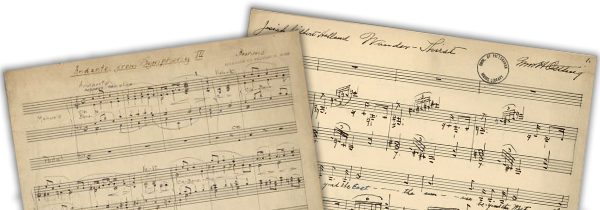

Harvey Bartlett Gaul was an American organist and composer.
Born in Brooklyn, New York, on April 11, 1881, Harvey Bartlett Gaul was an American organist and composer. He began his musical studies in New York with George F. Lejeune and later studied with Dudley Buck. In 1906 Gaul studied in England with Alfred R. Gaul (no relation) and Philip Armes. In 1909 and 1910 he attended the Conservatoire and the Schola Cantorum in Paris, where he studied organ with Charles Marie Widor and Abel Decaux, and composition and orchestration with Vincent d’Indy. While in Paris, Gaul served as the organist at St. Luke’s Chapel. He was the assistant organist at St. John’s Chapel, New York, from 1899 to 1900, and was organist and choirmaster at Emmanuel Church in Cleveland from 1901 to 1909. In Cleveland he also directed the Hough Choral Club and wrote music reviews for the Cleveland News.
In 1910, Gaul was appointed the organist of Calvary Episcopal Church in Pittsburgh, where he played a 3-50 Moller that was installed in 1907 and directed a boychoir of sixty and children’s choir of thirty. In addition to his duties at Calvary, Gaul also worked for the Pittsburgh Post-Gazette as a music critic from 1914 to 1934 and arts editor from 1929 to 1934. Beginning in 1929, he was the local correspondent for Musical America. Gaul conducted various choral groups, as well as the Pittsburgh Civic String Orchestra from 1936 to 1945 and the Savoyard Opera Company from 1939 to 1945. He served on the faculties of the University of Pittsburgh, Carnegie Institute of Technology, Washington and Jefferson College, and Fillion Studio of Music. He was the first music director for the radio station KDKA. A gifted teacher in organ and composition, he taught Garth Edmundson, Mary Wiggins, Gladys Rich, Marian Genet, Alice Stemple, and Alfred Johnson.
As a composer, Gaul is known chiefly for his songs and choral works, both sacred and secular. Of his more than 500 works, most were published during his lifetime, and some were published under the pseudonyms Will Deems, Lester Jenks, and Monte Wellings. His principal publishers were Schirmer, Ditson, Grey, and Birchard. Gaul’s arrangements of carols from various countries are noted for their strong rhythmic vitality, sense of the dramatic, and use of tunes unknown to most American ears. Gaul was an early proponent in his appreciation of the possibilities of African American spirituals, setting them in discreet treatments as vocal solos. His organ compositions are almost as well-known as his carol arrangements and are charming and idiomatic tor the instrument. The early pieces are easy and tuneful, while later ones call upon the resources of a modern organ but are never willfully difficult.
A prolific author and lecturer, his biography of the composer Stephen C. Foster, The Minstrel of the Alleghenies, appeared in 1952.[fn]Harvey Gaul, The Minstrel of the Alleghenies (Pittsburgh: Friends of Harvey Gaul, 1952).[/fn] Gaul passed away on December 1, 1945, and his cremains are entombed in the wall of the former Choir Hall, now the Refractory, at Calvary Episcopal Church. The Harvey Gaul Composition Contest, founded by the Friends of Harvey Gaul immediately after his death, bestowed the first of its annual cash awards in 1947. The Pennsylvania Federation of Music Clubs also established a scholarship in Gaul’s name after his death.

This is a collaboration between the Center for American Music, Theodore M. Finney Music Library, and Archives & Special Collections.